by Erika Soliven, Marketing Director at PowerShelter
·
Updated
Summary
Why outdoor charging is the lower-risk default for most warehouses and last-mile depots
Where riders charge their e-bike battery determines your fire compartmentation burden, ventilation requirements, and insurance exposure.
For most warehouses and depots, outdoor charging takes fire compartmentation and ventilation largely off the table and typically lowers insurance exposure.
When outdoor placement is not possible, sensor-monitored indoor charging with active suppression is the right alternative.
In the Netherlands, PGS 37-2 applies above 333 kg of lithium batteries per fire compartment (30 kg for damaged batteries); most last-mile depots don't reach that threshold.
Tesla Berlin moved e-bike battery charging outdoors, removing unmanaged lithium battery risk from inside a €5+ billion production facility.
Where batteries charge is a fire safety decision
For most warehouses and depots, outdoor charging is the lower-risk option: it keeps the battery out of the building, so compartmentation, ventilation and escape routes largely stop being your problem. Where outdoor placement isn't possible, indoor charging can work, but only in units that sense, cut power and suppress at the compartment level. Riders who commute on e-bikes will detach their battery and carry it somewhere to charge either way. The decision is where.
It is a decision more operators are being forced to make. E-bike fires in the UK doubled between 2022 and 2024, from 181 to 362 incidents, according to QBE Insurance's analysis of UK fire service records (March 2025). The same pattern of lithium-ion battery fire risk in commercial buildings is showing up across Europe.
The trade-offs: indoor vs outdoor charging in a warehouse or depot
The four variables that determine which option fits your site.
Indoor charging | Outdoor charging | |
|---|---|---|
Fire compartmentation | The charging area needs to be separated from occupied zones by fire-resistant construction. Retrofitting compartmentation into an existing warehouse layout can be costly depending on configuration. | The charging event sits outside the building. Compartmentation requirements do not apply to the charging point itself. |
Ventilation | Lithium-ion batteries can release flammable gases during charging. Adequate ventilation at room level requires engineering, not just an open window. | No ventilation burden inside the building. Outdoors, any vented gas disperses into open air rather than building up in a room. |
Egress routes | A charging area cannot be placed across an escape route. Dense depot layouts sometimes only surface this constraint when infrastructure is being positioned. | No impact on internal egress. |
Insurance exposure | Indoor charging near occupied areas, stock, or machinery raises the underwriter's site risk assessment. Some insurers issue formal conditions prohibiting indoor battery storage. | Moving charging outside the building, into individual compartments, typically lowers this exposure in the underwriter's assessment. |
Install effort | Depends on the room: a power supply near the charging area, and possibly compartmentation or ventilation work if the space wasn't designed for it. | A level surface and a power connection near the bike parking. No civil works in most cases; distance from the power supply is the main variable. |
Typical cost drivers | The unit plus any building work needed to make the room suitable. A sensor-equipped indoor unit costs more than a basic outdoor one. | The unit plus the cable run. Where outdoor space already exists, costs stay low; ROC Hilversum avoided €60,000–€70,000 in construction this way. |
When PGS 37-2 applies to your site, and when it doesn't
Depot operators across Europe are increasingly asked by insurers, building managers, and safety consultants whether their battery charging setup meets regulatory requirements. In the Netherlands, the relevant framework is PGS 37-2, the Dutch guideline for the safe storage of lithium-containing energy carriers. It isn't automatically binding, but municipalities and permit conditions can make it mandatory. Most warehouse and depot operators assume it applies to them. For the majority, it does not.
PGS 37-2 applies if more than 333 kg of lithium batteries is stored in a single fire compartment. A standard removable e-bike battery weighs approximately 2.5–4 kg, so a depot would need over 80 batteries in one compartment to approach that threshold. The exception is damaged or defective batteries, where the threshold drops to 30 kg, or roughly ten e-bike batteries awaiting collection.
Most last-mile warehouses and depots charge individual rider batteries sequentially and do not come close. For those operators, PGS 37-2 does not apply. The practical question becomes: which managed charging infrastructure reduces fire risk most effectively within standard fire safety obligations.
Outside the Netherlands, the picture varies. In Germany there is no direct public-law equivalent; instead, insurers and fire safety consultants typically refer to VdS 3103, the lithium battery guidance from VdS Schadenverhütung, the German insurance industry's loss-prevention body. If your sites span several countries, check which framework your insurer applies in each.
How to decide what your site needs:
Count your batteries. Estimate how many are stored at once in each fire compartment, including damaged ones awaiting collection.
Check the threshold. Above 333 kg per compartment (30 kg if damaged), PGS 37-2 applies. Below it, general fire safety obligations still do.
Look outside first. If you have usable outdoor space near the bike parking, charge there.
If indoors, specify the unit. Require gas sensing, automatic shut-off and suppression at the compartment level.
Get the paperwork. Choose equipment with documentation you can hand to your insurer and safety consultant.
Both PowerShelter lockers carry Declarations of Conformity that include EN 14470:2023 (EU and UK, plus Canada for the SmartShelter), and have been tested under thermal runaway conditions following VDMA 24994 methodology. For the full documentation, see PowerShelter certifications.
Why outdoor compartmentalized charging is the lower-risk default for most depots
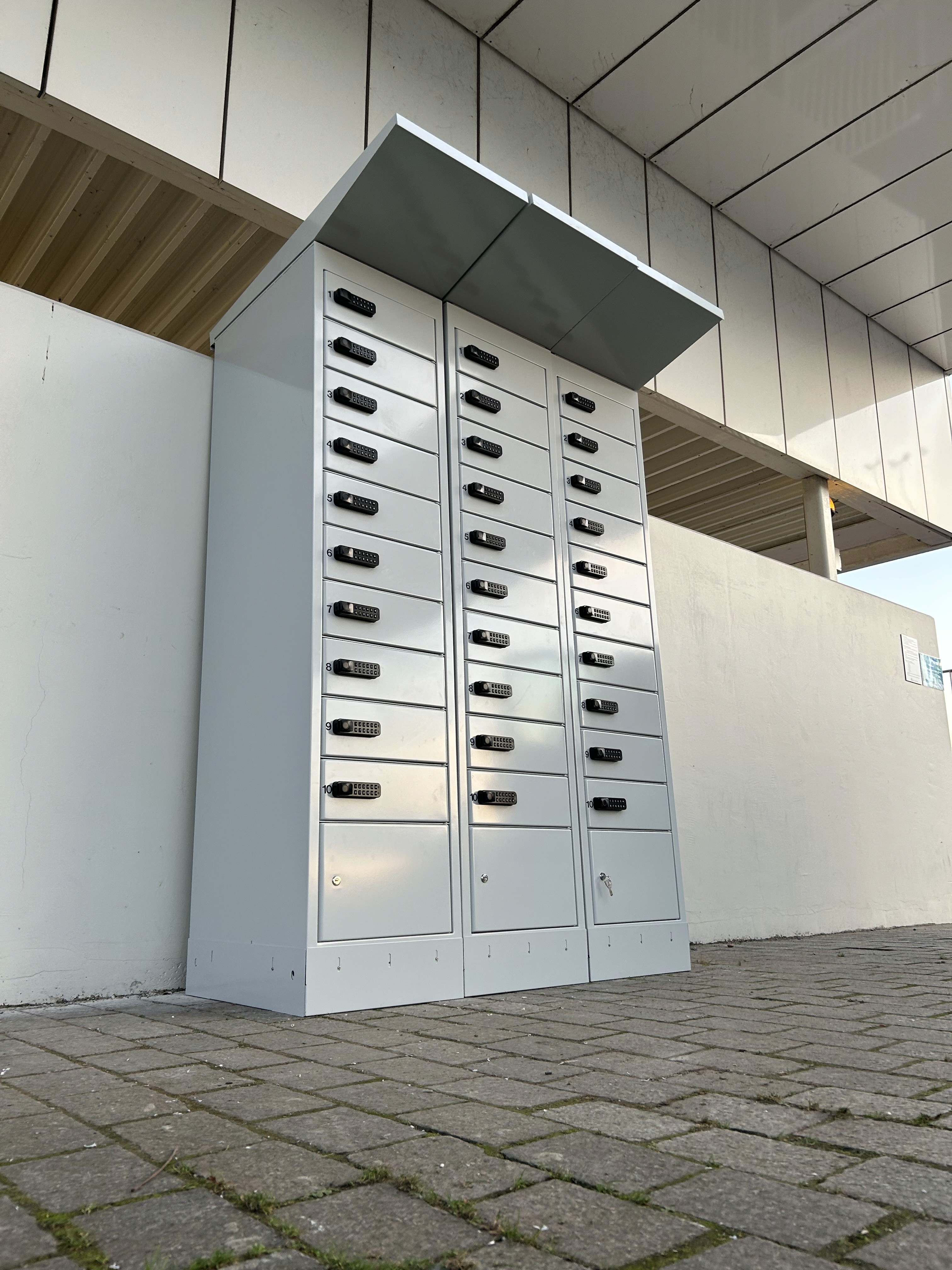
The CoreShelter is designed for outdoor installation with no civil works required and no disruption to site operations during install. Each unit is rated to IP54 (protection against dust and water splashing from any direction) and built in stainless steel.Each battery charges in its own stainless-steel compartment, while open air and distance from the building do the rest. Each unit includes an integrated 16A circuit breaker.
Three installations show how this plays out in practice:

Tesla Gigafactory Berlin had staff bringing personal e-bike batteries into the main facility and charging them at desks and along corridors, introducing unmanaged lithium battery risk into a controlled manufacturing environment. Four CoreShelter units installed at existing bike parking zones gave employees a safe, convenient place to charge outside the building instead.
Elsewhere, CoreShelter units went into three of DPD's Dutch distribution centers in two days. Google and World Wide Technology have installed them too.
"We are very satisfied with our collaboration with PowerShelter. Thanks to their flexibility, expertise and customer-focused approach, we were able to implement a suitable locker solution at multiple locations."
Kim van Uden, Contract Manager Facility, DPD Netherlands

Meanwhile, a Dutch campus operator avoided €60,000–€70,000 in construction costs by retrofitting two CoreShelter units to existing outdoor space — the same safety outcome for more than 80% less.
When indoor charging is the right call
Some sites cannot go outdoors: secure facilities with perimeter constraints, buildings where the site boundary prevents exterior placement, or operations where layout requires it.
For those situations, the SmartShelter is designed for both indoor and outdoor installation. Each compartment includes H₂ and CO gas sensors that trigger automatic shut-off at threshold, and temperature sensors that cut power when heat exceeds safe limits, flagging a developing fault at the earliest warning sign. If a thermal event does occur, an independent fire-suppression system and cooling and extraction fans work to contain the event and buy time for alarms and responders. Individually controlled compartment power and continuous monitoring give facilities managers visibility over what is charging and when — turning an unmanaged risk into a managed system.
DPD is doing exactly this across its Dutch network: CoreShelter units outdoors where the site allows it, and a SmartShelter planned for a location where indoor installation is the better fit. See how DPD matched the unit to each site.
PowerShelter makes outdoor and indoor e-bike battery charging lockers for depots, warehouses, and last-mile operations. Not sure which model fits your layout? Talk to our team.
FAQs
Is outdoor or indoor e-bike charging safer for a warehouse or depot?
Outdoor is the lower-risk default for most warehouses and depots. It moves the charging event outside the building, which takes fire compartmentation and ventilation largely off the table and typically lowers insurance exposure. When outdoor placement is not possible, sensor-monitored indoor charging with active suppression (gas detection, automatic shut-off, and per-compartment fire suppression) addresses the risk at unit level.
Can outdoor e-bike charging lockers integrate with existing access control systems?
Yes. CoreShelter units can be fitted with RFID locks compatible with standard employee badge systems. At Tesla Gigafactory Berlin, the lockers were integrated with the site's existing MIFARE badge system (a widely used contactless card standard), so staff could use their standard access card to secure a charging compartment without additional keys or apps. CoreShelters can be configured to work with different access control systems.
How do depot operators manage e-bike charging capacity across multiple staff shifts?
CoreShelter compartments can be configured with time-based lock logic to keep capacity available across shift rotations. At Tesla Gigafactory Berlin, a 12-hour cycle opens compartments automatically after 12 hours, preventing long-term occupation and ensuring arriving shifts find available charging. For indoor SmartShelter installations, individually controlled compartment power and remote monitoring give facilities managers visibility over usage patterns, so capacity can be managed without manual oversight.
What are the insurance implications of charging e-bike batteries indoors in a warehouse?
Underwriters assess where batteries are charged as part of commercial site risk evaluation. For businesses handling lithium-ion batteries, insurers are increasingly imposing stricter underwriting conditions, including higher premiums, coverage exclusions, and requirements to evidence fire mitigation systems and third-party certification, according to a 2025 analysis of the UK insurance market by law firm Hogan Lovells Cadwalader. Both CoreShelter and SmartShelter carry Declarations of Conformity that include EN 14470:2023, and have been tested under thermal runaway conditions following VDMA 24994 methodology, giving operators a documented safety specification to present to their broker. This varies by market and insurer, so speak to your broker about the specific implications for your site.
Does PGS 37-2 apply to my depot or warehouse in the Netherlands?
It depends on how much lithium battery weight you store in a single fire compartment. PGS 37-2 applies once more than 333 kg of lithium batteries is stored per fire compartment. A standard removable e-bike battery weighs approximately 2.5–4 kg, so a depot would need over 80 batteries in one compartment to approach that threshold. Most last-mile depots charge individual rider batteries sequentially and do not come close. The exception is damaged or defective batteries: the threshold drops to 30 kg, roughly ten e-bike batteries awaiting collection or disposal. The same thresholds apply regardless of building type, whether an office building, university campus or public institution. PGS 37-2 is a guideline rather than a law in its own right, but municipalities can make it mandatory through permit conditions. If you operate a high-volume depot or centralized battery hub, calculate your on-site battery mass per fire compartment and verify with a compliance consultant.
If e-bike battery charging regulations don't apply to my site, does that mean charging is unregulated?
No. General fire safety legislation, employer health and safety obligations, and building regulations apply regardless of whether a specific threshold regulation is triggered. The threshold determines whether those specific requirements apply, not whether fire safety obligations exist. Duty of care to employees and visitors, local building code compliance, and your insurance obligations remain in force at any volume.