Client
DPD Netherlands
(Warehouse and Parcel Depots)
Hardware
2x CoreShelters, one per site
1x SmartShelter planned for another site
1x CoreShelter planned for another site
PIN access
Users
Warehouse and depot staff commuting by e-bike
Impact
Employee e-bike charging moved outside the warehouse building
No groundworks or disruption to depot operations
One supplier, simpler rollout across multiple sites with different needs
Results
Second site adopted after the first proved itself internally
Rollout continuing across further DPD sites
CHALLENGE: A fire stops operations, but the costs keep running
A lithium-ion battery fire in one of DPD's warehouses changed how the business thought about charging. By 2025, the company was looking for a fire-safe solution for the growing number of staff arriving at work by e-bike.
For a parcel operator, a fire is not only a property loss. A warehouse that stops moving still has staff on shift, vehicles on site, and volume backing up behind it. The building stops. The costs do not.
That experience changed how DPD looked at a trend already underway on its own sites. More staff were arriving at work by e-bike, detaching batteries, and looking for somewhere to charge during a shift. There was nowhere designated to do it, so charging happened wherever there was a socket.
The complication was that DPD does not have one kind of site. Its locations differ in layout, in available power, and in what can physically be installed outside. An answer that suited one warehouse would not necessarily suit the next. Facilities teams running multiple warehouse and depot sites tend to hit exact wall: the charging problem is identical everywhere, and the workable solution is not.
SOLUTION: A locker for each site, built to contain a battery fire
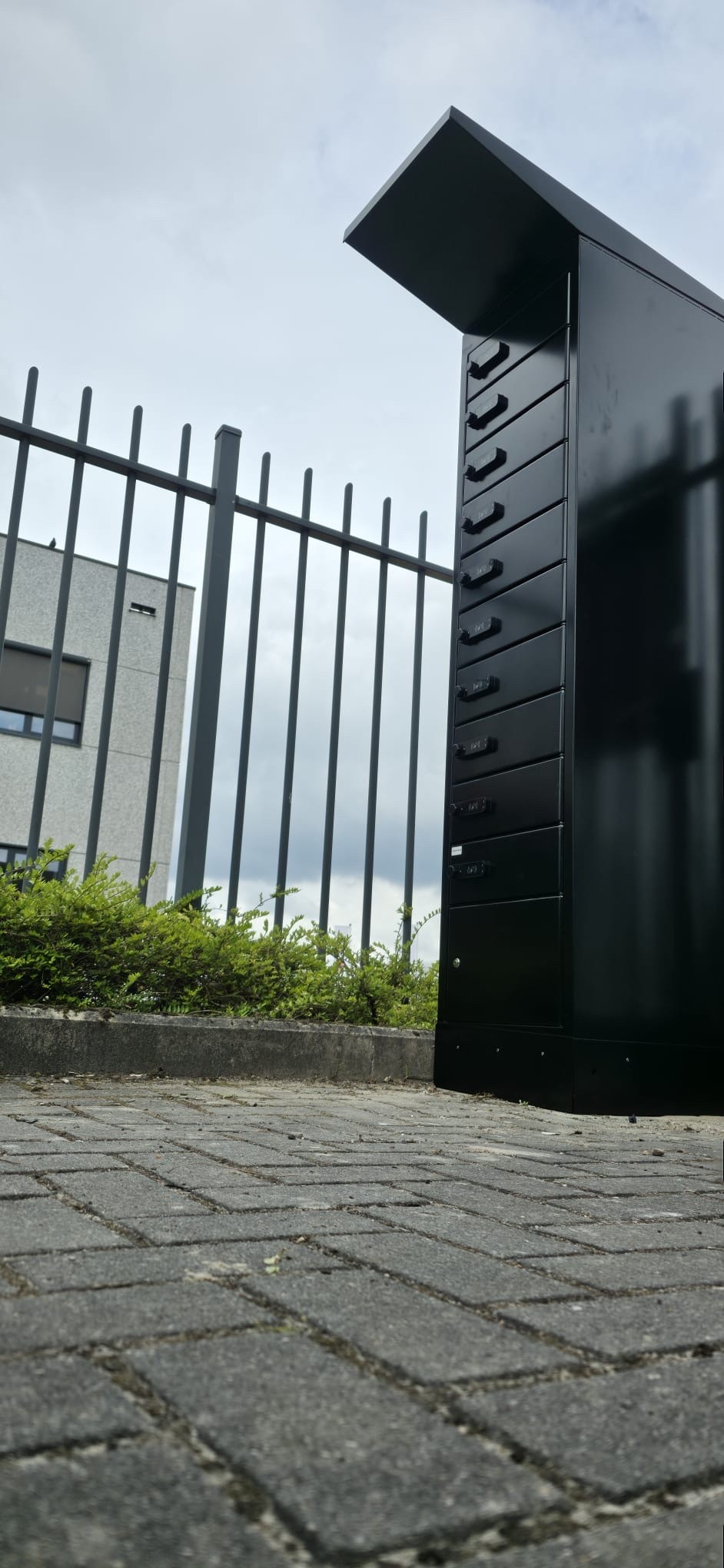
PowerShelter supplied two outdoor CoreShelter units for DPD locations where outdoor charging works, with a SmartShelter and a third CoreShelter planned for two further sites. Working with DPD's contract manager for facilities, the approach covered several locations rather than treating any one site as the whole problem.
Outdoor where outdoor works. The CoreShelter is built for permanent outdoor installation, weatherproof to IP54, with EV-grade mica sheet lining, stainless steel construction and a 16A circuit breaker per unit. A thermal event stays in the compartment. Charging happens entirely outside the warehouse building.
Active suppression where the site needs it. A SmartShelter is planned for a location requiring indoor installation and active fire suppression. It installs indoors or outdoors and carries an independent fire-suppression system in each compartment, gas and temperature sensors with automatic power cut-off, and extraction fans.
IMPACT: Fire-safe charging becoming a standard across DPD sites
KEY TAKEAWAY: A charging ban is not a charging policy
Most warehouse and depot operators reach the same rule DPD did: no charging e-bike batteries inside the building. The rule is correct and, on its own, unenforceable. Staff still need to charge, so a ban with no alternative produces hidden charging rather than no charging.
The harder problem for a multi-site operator is that the answer is not the same everywhere. Power availability, outdoor space and building type differ from one warehouse to the next, and a supplier with a single product forces every site into it. Matching the unit to the site, outdoor where outdoor works and indoor where it does not, is what turns a policy into something that gets installed. The trade-offs between the two are set out in: Indoor vs Outdoor E-bike Charging for Warehouses.