by Erika Soliven, Marketing Director at PowerShelter

Summary
Uptime: Swapping eliminates charging downtime entirely. Fixed charging costs couriers hours per shift, including a detour home.
Cost per courier: Swapping removes the need for a personal spare battery per courier. Fixed charging means the fleet still owns and manages a personal spare for every courier on the roster, whether they're working or not.
Fire and theft liability: Swapping moves battery risk into a fire-rated, monitored network. Fixed charging leaves that risk unmonitored with the courier, unless they have access to a dedicated fire-rated locker.
Best fit: Swapping wins for fleets spread across multiple sites or with distributed courier bases. Fixed charging can still work for a single site, even round-the-clock, as long as everyone returns to the same depot.
For delivery fleets with couriers across multiple locations, battery swapping wins on uptime and cost per courier. It takes the e-bike battery, and the risks and downtime that come with it, off your couriers entirely. Of course, fixed charging still has a place: a single site with predictable shift patterns, where every courier starts and ends at the same depot.
Why fleet operators are asking this question now
Cargo e-bikes are already outperforming delivery vans on cost and carbon. GPS-tracked research from the University of Westminster found cargo bikes cut carbon emissions by 90% compared with diesel vans on London delivery routes, while also delivering parcels faster than vans. This is driving fleets to put more couriers on the road, but it’s exposing a decision most operators haven’t made deliberately: how and when do those couriers actually get power into their batteries?
Three models compete for that job: charging overnight at home, carrying a spare battery, or returning to a depot to plug in. Home charging looks free until the fire risk it’s quietly carrying gets counted. A spare battery is real capital the moment it’s bought, and depot charging only works while a courier’s shift happens to line up with a free charger. Either way, the full cost shows up later: in lost shift hours, in spare-battery capital that scales with every new courier, and in fire risk nobody signed up to own, all covered in more depth on our delivery and logistics infrastructure page.
Uptime vs downtime: how much riding time each model costs your couriers
A charging e-bike battery takes hours to refill. For a courier mid-shift, that’s not downtime you get back. It’s a stop that either ends the shift early or forces a detour to a depot or home, both of which take time away from paid deliveries. Multiply that across a fleet and it stops being just an inconvenience.
Battery swapping changes the shape of the problem entirely. A courier on PowerShelter’s SmartSwapping network finds a station on their route, swaps a depleted battery for a fully charged one in under a minute, and keeps moving. No plug, no wait.
Cost per courier: who owns the capital
Charging looks cheap because electricity is cheap. But that’s not where the real cost lives. The real cost is capital, and specifically, the second battery.
Every bike needs one battery to operate, so that part of the equation never changes. What changes is whether each courier also needs a personal spare to stay on the road. Under fixed charging, they do: one battery in use, one charging in rotation, per person, whether that courier is on shift or not. The spare doesn’t earn anything. It just exists to cover the gap.
Swapping removes that second battery entirely, without adding anything new to the fleet’s own books. Instead of each courier relying on a dedicated spare, they all draw from a common pool. They swap at different times, so the same batteries serve far more people than one spare each would. And none of this sits on the fleet operator’s balance sheet. It’s infrastructure they access through PowerShelter, not capital they have to buy to help their couriers.
Battery Swapping | Fixed Charging | |
|---|---|---|
Uptime per courier | No charging downtime; swap takes under a minute | Full charge takes hours; couriers lose shift time or carry heavy spares |
Spare battery capital | None owned by the fleet; couriers draw from a shared battery pool | Fleet buys and maintains 1+ spare batteries per courier on the roster |
Fire risk ownership | Batteries charge inside fire-rated, monitored SmartSwapping stations | Safe with a dedicated fire-rated locker; otherwise unmonitored if couriers charge wherever they can |
Theft/damage risk | Batteries stay inside a locked, monitored network | Spare batteries in depots or homes, or attached to bikes are a common theft target |
Best fit | Multi-site, high-mileage, distributed courier bases | Single site, predictable shifts, low courier turnover |
Scaling to a new city | Infrastructure build-out is shouldered by the network, not the fleet | Fleet owns the infrastructure decisions and costs, at every new site |

Fire and theft liability: who’s actually holding the risk?
For a fleet, a battery fire isn’t just a safety statistic, it’s also a liability question. If a fire starts on your premises, or in a courier’s home while they’re charging equipment you supplied, that liability typically sits with the fleet, not the courier. The numbers make this current, not hypothetical: fire brigades across the UK are now responding to a lithium-ion battery incident roughly every five hours, a 250% jump in e-bike fires over three years, according to The Guardian (May 2026). Germany’s IFS (Institut für Schadenverhütung und Schadenforschung) puts the figure at three in four battery fires starting during charging, which is precisely the moment informal charging—batteries at home, in a depot, plugged in with no one watching—has the least visibility.
That risk is specific to informal charging, not to fixed charging as a category. A dedicated, fire-rated charging locker closes the same gap, monitored and contained, the same way swapping does. What it doesn’t do is cover more than the one site it’s installed at.
Swapping changes who’s holding that risk across every site a fleet operates from. Every battery on PowerShelter’s SmartSwapping network returns to a fire-rated, monitored unit built to contain a thermal event, not whatever plug socket a courier had access to. That also gets spare batteries out of storerooms, out of the courier’s personal belongings, out of areas where battery theft tends to happen.
Where fixed charging still wins
None of this makes fixed charging wrong. It’s the right call when a single site has access to fire-rated charging infrastructure: everyone comes back to the same depot, and there’s no distributed courier base to serve. VOK Bikes runs exactly this profile for one of their locations. A single SmartShelter unit gives its cargo fleet round-the-clock, unsupervised battery access from one location, with no distributed network needed at all, and none of the fire risk that comes with charging informally, the same fire-rated containment swapping offers, just scoped to one site. Building a swapping network for a single depot is more infrastructure than the problem calls for.
The moment a fleet adds a second site, extends hours, or takes on couriers who don’t return to base at the same time each day, the calculation tips toward a battery swapping network.
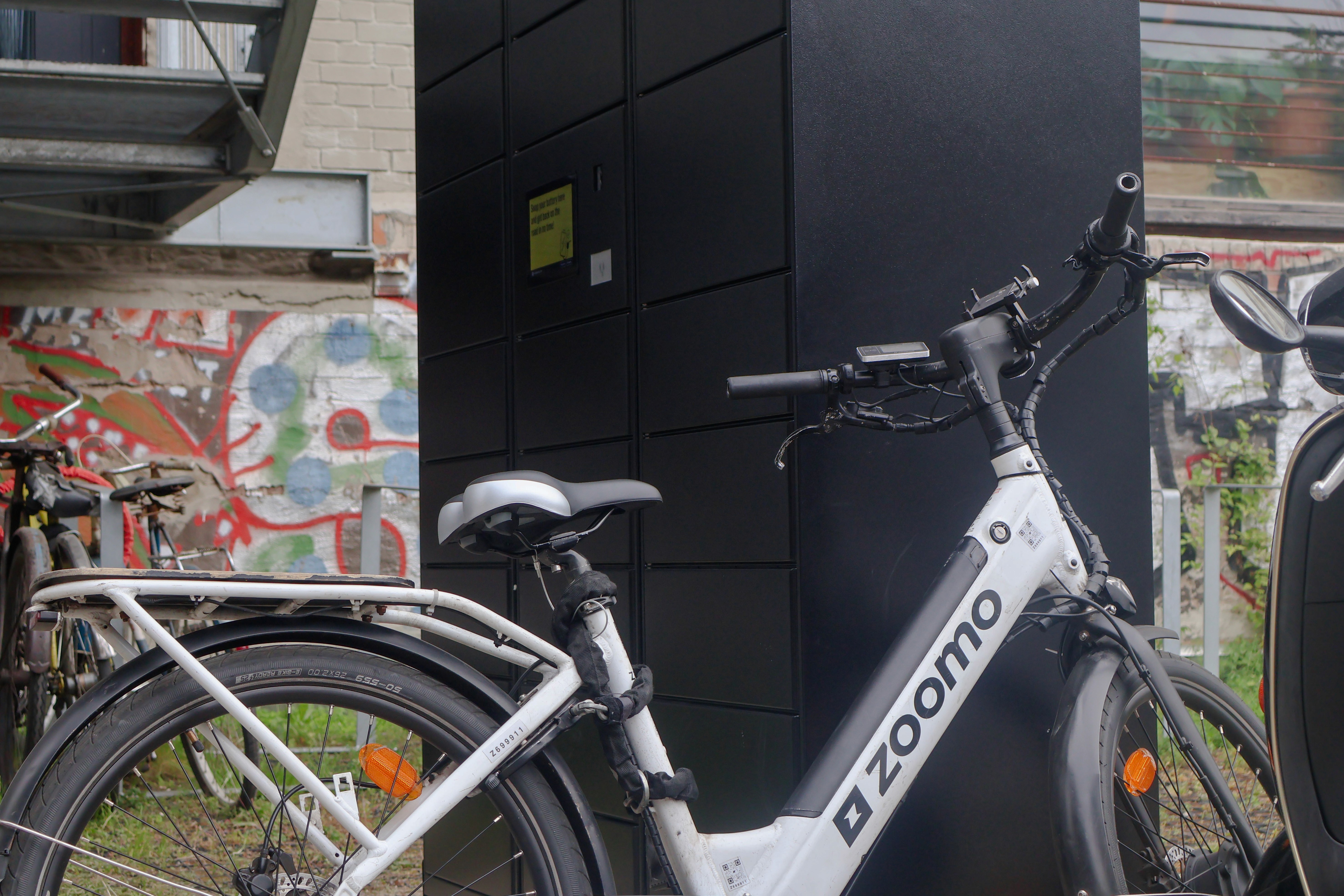
Proof point: PowerShelter x Zoomo in Berlin
This is the model behind PowerShelter’s partnership with Zoomo, the e-bike leasing platform for last-mile delivery couriers. A courier who subscribes to Zoomo can ride, swap and deliver, without Zoomo having to manage charging infrastructure or spare battery logistics.
The SmartSwapping network launched in Berlin and currently has three live swapping stations, each with three SmartShelters and batteries available around the clock. Ten total locations are planned, serving roughly 650 delivery riders across Berlin.
Zoomo’s Head of Operations Germany, Mazin Lammers, summed up what it means on the ground:
Riders can now swap instantly, ride lighter and longer. Small thing. Big difference.
SmartSwapping is built to be open-access, battery-agnostic and scalable, which means fleet providers can plug into the network without having to build their own charging infrastructure. The launch was independently covered by Zag Daily and Micromobility Industries.
FAQs
How does the swapping-vs-charging math change once a fleet is running multiple shifts across more than one depot?
Single-site, single-shift fleets can absorb fixed charging's inefficiencies because there's slack in the schedule: a battery goes on the charger between shifts and comes off in time for the next one. Add a second depot, overlapping shifts, or couriers who don't return to the same site each day, and that slack disappears. Every additional site under fixed charging means the fleet buying and installing its own charging hardware for that location, plus a spare battery for every courier there, on top of the one already in each bike. The capital commitment grows with every site added.
Under swapping, a second site still gets its own station, but it's part of PowerShelter's shared network, not equipment the fleet has to buy or install itself. Couriers draw from that shared pool instead of a personal spare, so there's no second battery for the fleet to own at all. Both the uptime case and the cost case hold at any scale: more sites, more shifts, and more complex routing only make fixed charging harder to manage. They don't change what swapping delivers.
Does moving from home or depot charging to a swapping network actually reduce fire liability, or does it just relocate the same risk?
It's a fair challenge, since a battery still has to charge somewhere either way. The difference is what that "somewhere" is built to handle. That risk sits with informal charging specifically, a depot or a courier's home with no fire-rated containment and no one watching overnight, not with fixed charging as a whole. A dedicated, fire-rated charging locker closes that same gap for a single site. Under PowerShelter's SmartSwapping model, every battery returns to a fire-rated, monitored unit at any station across the network. The risk doesn't disappear, batteries still charge, but it moves out of uncontrolled spaces and into infrastructure engineered for exactly this failure mode everywhere a fleet operates, not just at a single site. That's a real reduction in exposure, not a relabelling of the same exposure.
At what point should a fleet switch from fixed charging to battery swapping?
Fixed charging still wins when a fleet operates from a single site: couriers start and end their day at the same depot, and there's no distributed courier base to serve, whatever hours that site runs. Building a swapping network for that setup is more infrastructure than the problem calls for. The calculation flips once a fleet adds a second site, or takes on couriers who don't return to the same depot each day. At that point, the fleet has to make and fund a new charging infrastructure decision at every site, while a swapping network scales across sites without that repeated decision.
How much uptime does a courier actually recover by switching from charging a spare battery to swapping mid-shift?
Swapping can recover close to five hours of riding time a week for a courier, compared with charging. That gap comes from two places: how long a full charge takes, which can run to hours if there's no spare to fall back on, versus a swap done in under a minute, and the shift time lost detouring to a depot or home to charge. On PowerShelter's Amsterdam Rider Network, courier Osama documented saving nearly an hour of earning time a day by swapping at his local station in central De Pijp rather than riding home and back to switch batteries.
What did Zoomo's Berlin operation actually gain from joining a shared swapping network?
By joining PowerShelter's SmartSwapping network, Zoomo, which provides e-bikes for last-mile delivery riders, could support its couriers in Berlin without ever having to build, fund, or manage charging infrastructure of its own. The network handles the stations, the batteries, and the logistics. Zoomo's own team has pointed to the effect on couriers directly: less weight to carry, and no downtime lost to charging mid-shift.
Ready to find out which model fits your fleet? Talk to our team.